Onsite-verified titanium fastener manufacturer · Baoji, China · Since 2015
Why Choose Titanium Bicycle Screws for Your Bike?
For many cyclists, small hardware deserves more attention than it receives. Titanium Bicycle Screws offer a practical balance of low weight, corrosion resistance, and dependable strength. They can replace heavier steel screws on bottle cages, stems, brake fittings, and derailleur accessories. The difference may feel tiny in your hand. Across several components, however, every gram can support a cleaner, more responsive build.
Lennard Zinn, a respected bicycle engineer and technical author, describes titanium as “strong, light, and corrosion-resistant.” That simple observation explains its popularity among experienced mechanics and performance-focused riders. Titanium does not rust like ordinary steel. It also keeps its appearance after wet commutes, salty roads, and repeated washing. Still, it is not magic. Titanium screws can gall when threads are installed dry, and their lower stiffness may not suit every high-load application. Use the correct grade, torque setting, and anti-seize compound. Follow the component manufacturer’s instructions.
A careful upgrade matters.
My own practical view is more cautious. Titanium Bicycle Screws make sense when weight, durability, and appearance matter together. They are less convincing when replacing structural fasteners without checking specifications. A shiny screw cannot compensate for poor installation. Riders should inspect threads, use a calibrated torque wrench, and avoid mixing unsuitable materials. The best choice depends on the bicycle, riding conditions, and maintenance habits. In other words, titanium can be excellent, but only when selected with discipline.
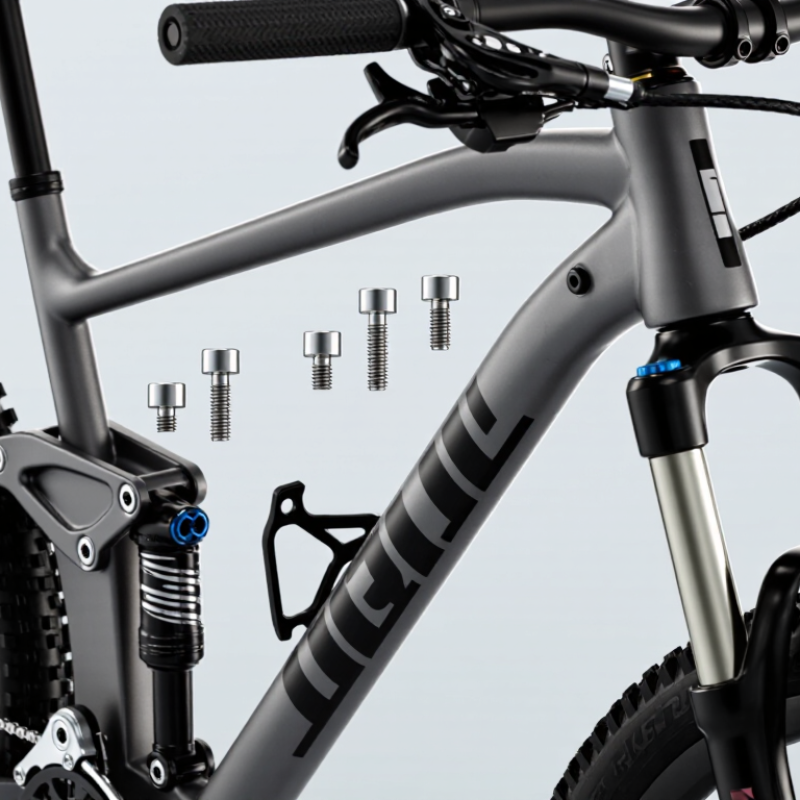
Why Choose Titanium Bicycle Screws for Your Bike?
Titanium bicycle screws reduce weight through a simple material advantage. Titanium has a density of 4.51 g/cm³, while common steel measures about 7.85 g/cm³. For identical screw dimensions, titanium weighs roughly 43% less than steel. The saving seems small per screw. Across bottle cages, seat clamps, stem accessories, and brake fittings, it can become measurable. Every gram matters to some riders.
Titanium also resists corrosion, which helps on wet roads and salty coastal routes. Its clean surface stays attractive after repeated cleaning. However, titanium is not automatically the strongest choice for every connection. Steel can offer higher tensile strength and lower cost. Correct grade, thread condition, and tightening torque still matter. Titanium threads may gall if installed dry, especially under repeated adjustment. A thin, compatible assembly compound can reduce that risk. I would not replace every screw blindly. The 43% figure describes material density, not total bicycle weight.
Tips: Weigh the original screws first. Measure before buying. Match the correct thread size and length. Use a calibrated torque wrench, following the component maker’s specification. Inspect threads during maintenance. A lightweight screw cannot compensate for poor fit, excessive torque, or damaged hardware. When in doubt, keep safety-critical fasteners conservative.
Titanium bicycle screws appeal to riders who want lower weight without sacrificing mechanical strength. Grade 5 titanium, or Ti-6Al-4V, has a density near 4.43 g/cm³, compared with about 7.85 g/cm³ for common steel, according to ASM Handbook materials data. That difference can reduce weight around bottle cages, stems, saddles, and derailleur fittings. The saving is modest per screw. It becomes more noticeable across a complete build.
The important figure is not marketing language. ASTM B348 specifies a minimum tensile strength of 895 MPa for Grade 5 titanium products. It also lists a minimum yield strength of 828 MPa and 10% elongation for the specified condition. These values explain why properly sized titanium screws can handle demanding bicycle loads. However, tensile strength alone does not prove suitability. ISO 4210 bicycle safety testing focuses on fatigue and component performance, not simply material strength. Thread engagement, clamp length, and installation torque still matter.
In practical workshop use, titanium resists corrosion well and remains attractive after years of road spray. It is not automatically stronger than every steel fastener. That point deserves honesty. Titanium threads can gall when installed dry, especially under repeated adjustments. A suitable anti-seize compound and a calibrated torque wrench reduce that risk. I would also avoid replacing structural steel bolts without checking the original specification. A lighter screw is useful. Correct engineering matters more.
Why Choose Grade 5 Titanium Bicycle Screws?
Grade 5 titanium has a minimum tensile strength of 895 MPa under ASTM B348, exceeding the listed reference values for 304 stainless steel and 6061-T6 aluminum. Its high strength-to-weight ratio makes it well suited to bicycle components where strength and weight reduction are important.
Why Choose Titanium Bicycle Screws for Your Bike?
A bicycle faces rain, sweat, road salt, and trapped moisture around fasteners. Titanium responds differently from ordinary steel. When exposed to oxygen, it rapidly forms a tightly bonded titanium oxide film. Materials references, including ASM Handbook data, describe this passive layer as only a few nanometers thick. Despite its size, the film separates the metal from water and dissolved salts. If scratched, it can reform quickly in normal air.
This matters most around bottle cages, seat clamps, and exposed cockpit hardware. NACE’s IMPACT study estimated that corrosion costs the global economy about 3.4% of GDP annually. A bicycle is much smaller, but its fasteners still experience repeated wet-dry cycles. Titanium’s density is about 4.5 g/cm³, compared with roughly 7.9 g/cm³ for steel. The weight saving is modest. The stable oxide layer is often the stronger reason to choose it.
Still, titanium is not maintenance-free. Its passive film performs well, but stagnant saltwater can remain inside threads. Titanium can also gall during tightening, especially with dry threads and excessive torque. I would use suitable assembly compound and follow the frame maker’s torque guidance. One overlooked issue is galvanic coupling with aluminum. In salty moisture, titanium may contribute to aluminum corrosion at the joint. ASTM G31 immersion testing and ASTM G48 corrosion methods can help evaluate materials, but real riding conditions are less predictable. That is where practical inspection remains necessary.
| Data Dimension | Titanium Bicycle Screws | Stainless-Steel Screws | Aluminum Screws | Practical Bicycle Implication |
|---|---|---|---|---|
| Typical material used for fasteners | Commercially pure Grade 2 or titanium alloy Grade 5 (Ti-6Al-4V) | Commonly austenitic stainless-steel grades such as 304 or 316 | Commonly high-strength aluminum alloys such as 7075-T6 | Material grade should match the load, thread design, installation torque, and safety requirements of the component. |
| Density | Approximately 4.5 g/cm³ | Approximately 7.9–8.0 g/cm³ | Approximately 2.8 g/cm³ | Titanium is about 43% lighter than typical stainless steel, while aluminum is lighter still but generally has lower strength and wear resistance. |
| Passive oxide layer | Forms rapidly when fresh titanium is exposed to air or water; the stable surface film is primarily titanium dioxide. | Forms a chromium-rich passive film that can protect the underlying steel when oxygen is available. | Forms a thin aluminum-oxide film that can protect the surface but may be vulnerable in strongly acidic or alkaline conditions. | Titanium’s passive film greatly slows further oxidation and helps protect the fastener surface from many wet and salty environments. |
| General corrosion resistance | Excellent in seawater, humid air, and many chloride-containing environments | Good to excellent, depending strongly on the grade and environment | Good in many atmospheric conditions, but more sensitive to galvanic and chemical attack | Titanium is a strong option for bicycles used in rain, coastal climates, winter road salt, or frequent washing. |
| Resistance to chloride exposure | Very high; titanium is widely used in seawater-related applications | Varies by grade; chloride exposure can cause pitting or crevice corrosion, especially in less resistant grades | Moderate; chloride-containing moisture can increase pitting and galvanic-corrosion risk | Rinsing and drying remain important because trapped moisture and deposits can create localized corrosion conditions. |
| Resistance to rust staining | Does not form conventional iron rust | May develop surface staining or localized corrosion if the passive film is damaged or the environment is aggressive | Does not form conventional iron rust, but can pit or develop white corrosion products | Titanium can help maintain a clean appearance around exposed bottle-cage, cockpit, seat-post, and accessory fasteners. |
| Strength-to-weight characteristic | High strength-to-weight ratio, particularly for Grade 5 alloy fasteners | Generally high strength, but with greater mass | Low mass, but lower stiffness and thread durability than many steel or titanium fasteners | Titanium can reduce fastener weight without the large mass increase associated with steel, provided the fastener is correctly specified. |
| Thread galling tendency | Relatively high, especially when titanium threads run against titanium or are installed dry | Possible, particularly with stainless-steel-on-stainless-steel threads | Usually lower than titanium, but soft threads can deform or wear under repeated installation | Use clean, compatible threads and an appropriate anti-seize compound when permitted by the component manufacturer. |
| Galvanic-corrosion consideration | Can form a galvanic couple with dissimilar metals in the presence of an electrolyte, despite its excellent passive film | Can also participate in galvanic corrosion, depending on the metal pairing and electrical contact | More vulnerable when electrically coupled to nobler metals such as titanium or stainless steel in wet conditions | Keep interfaces clean and dry where possible; use suitable isolation methods if recommended for the frame or component. |
| Best-suited bicycle applications | Lightweight hardware, bottle cages, fenders, racks, accessory mounts, and selected non-critical fasteners | High-load or wear-prone applications where mass is less important and the correct grade is available | Low-load accessories where minimal weight is the priority | Never replace a safety-critical fastener solely to save weight; follow the bicycle or component manufacturer’s specification. |
| Care and maintenance | Inspect threads, avoid cross-threading, use correct torque, and clean off abrasive or salty deposits | Inspect for pitting, staining, and damaged threads; clean and dry after exposure to salt or chemicals | Inspect for pitting, thread deformation, and contact corrosion; avoid excessive torque | Correct torque and regular inspection are more important than material choice alone for long-term fastener reliability. |
Titanium bicycle screws offer low weight, strong corrosion resistance, and a clean metallic finish. However, their threads need careful handling. Titanium can gall when two dry titanium surfaces rub under pressure. The threads may weld locally, then tear during tightening. Sometimes, the screw locks before reaching the correct clamping force. It is frustrating, and easily overlooked.
NASA-RP-1228 identifies titanium fasteners as vulnerable to thread galling and recommends suitable lubrication. ASTM G98 provides a recognized method for evaluating galling resistance, although bicycle assembly rarely includes laboratory testing. In workshop practice, I inspect every thread, keep parts clean, and apply a thin anti-seize film. Not too much. Excess compound can attract grit near exposed frame fittings. A torque wrench remains important because lubricant changes friction and can increase clamp load at the same torque setting.
Use the bicycle maker’s torque value, then verify whether that value assumes dry or lubricated threads. FAA AC 43.13-1B also stresses controlled tightening and approved materials for critical fasteners. That principle fits bicycles well. A small, compatible anti-seize layer can prevent expensive thread damage, but it is not a cure for crossed threads or damaged parts. I once assumed a smooth-looking screw was safe; it was not. The threads showed faint tearing under bright light. Titanium is light. Its installation deserves patience.
Titanium bicycle screws can reduce weight and resist corrosion, but safety depends on selection, not appearance. Grade 5 titanium offers high strength for many stem, bottle-cage, and accessory applications. Grade 2 is softer and better suited to lightly loaded parts. Do not replace structural fasteners automatically. ISO 4210-2 defines bicycle safety requirements and test methods, yet it does not make every titanium screw suitable for every joint. The U.S. CPSC reported an estimated 457,266 bicycle-related, emergency-department-treated injuries in 2022. Small fastening errors deserve serious attention.
Choose the original thread size, diameter, and engagement length. A screw that is too long can damage hidden components. A short screw may strip under vibration. Torque must follow the component maker’s specification, because lubrication and titanium’s lower friction change clamping force. A calibrated torque wrench is essential. Titanium can gall, especially during repeated installation, so clean threads and suitable anti-seize compound matter. I still recheck critical fasteners after the first ride; that extra step is easy to overlook.
Tips: Match the screw’s material and grade to the joint. Check ISO 4210 guidance and relevant ASTM fastener specifications. Never copy a torque value from another component. Mark inspected screws with a removable paint line, then check movement, corrosion, or damaged threads during maintenance.
Grade 5 titanium is also called Ti-6Al-4V. It offers high strength with relatively low density.
Titanium has a density near 4.43 g/cm³, compared with about 7.85 g/cm³ for steel. One screw saves little. A complete build shows more difference.
Properly sized screws can handle demanding bicycle loads. Grade 5 titanium has a minimum tensile strength of 895 MPa. Strength alone is not enough.
They may suit bottle cages, stems, saddles, and derailleur fittings. Structural replacements require careful specification checks.
Titanium quickly forms a thin oxide layer in air. This film helps protect the metal from rain, sweat, and road salt.
No. Saltwater can remain inside threads, especially around exposed seat clamps or bottle cages. Regular inspection still matters.
Apply a suitable anti-seize compound before installation. Use a calibrated torque wrench and follow the recommended torque.
They can contribute to galvanic corrosion when titanium contacts aluminum in salty moisture. Clean and inspect the joint regularly.
No. Steel may remain more suitable for some structural applications. Check the original specification before making a replacement.
No. Fatigue testing, thread engagement, clamp length, and installation torque also affect performance. Real riding conditions can still surprise us.
Titanium Bicycle Screws offer an effective balance of low weight, strength, and durability for bicycle applications. With a density of approximately 4.51 g/cm³, titanium fasteners can reduce weight by about 43% compared with steel screws while maintaining excellent mechanical performance. Grade 5 titanium meets the ASTM B348 minimum tensile strength of 895 MPa, making it suitable for many safety-conscious bicycle components when properly selected and installed.
Titanium’s natural passive oxide layer provides strong resistance to corrosion, including exposure to moisture, sweat, and road conditions. However, titanium threads can be vulnerable to galling, so a suitable anti-seize compound should be applied during installation. Safe use also depends on choosing the correct titanium grade, screw size, thread type, and applicable standard, followed by tightening to the manufacturer’s specified torque. Proper inspection and installation are essential to ensure reliable performance and bicycle safety.